
Standard types of oil seals as per DIN 3760

The manufacturing technique and processes utilized in producing the standard oil seal types as per DIN 3760 (shown below) come as a result of long years of experience in the field of oil seal production, and are designed to meet a wide range of sealing requirements. They are produced with or without an extra dust lip. These standard types of oil seals are suitable for sealing both liquid and gaseous media (for application within a separated chamber). There also are multiple varieties of these basic types: types with grooved outside diameter, types with additional lips, types with bidirectional helix, etc. More information on these varieties can be found in our Additional Types section.
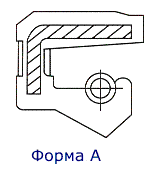
With its rubber covered OD, one sealing lip and a garter spring, type A oil seal is a low-cost solution with a most versatile application. This type can accommodate considerable surface roughness and thermal expansion on the housing seat. Suitable for sealing gaseous or low viscosity media. |
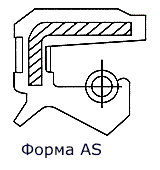 Same
features as those of type A with the addition of a dust lip for dirt
exclusion and corrosion protection.
The gap between the sealing lip and the dust lip can be additionally
filled with a suitable type of grease to prevent corrosion and rapid wear of
the shaft. One of the most widely used designs. Same
features as those of type A with the addition of a dust lip for dirt
exclusion and corrosion protection.
The gap between the sealing lip and the dust lip can be additionally
filled with a suitable type of grease to prevent corrosion and rapid wear of
the shaft. One of the most widely used designs.
|
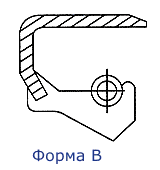 Type
B features an outer metal case and is used when greater extraction force is
necessary. Like type A, type B has one sealing lip and a garter spring. Sealing
is more difficult with housing seats of considerable surface roughness and
subject to thermal expansion: it requires a more precise finish of the seat
because it cannot compensate for its expansion. Type
B features an outer metal case and is used when greater extraction force is
necessary. Like type A, type B has one sealing lip and a garter spring. Sealing
is more difficult with housing seats of considerable surface roughness and
subject to thermal expansion: it requires a more precise finish of the seat
because it cannot compensate for its expansion. |
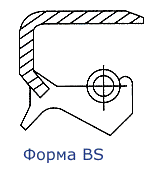 Same
features as those of type B with the addition of a dust lip. Same
features as those of type B with the addition of a dust lip. |
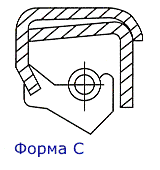 Type
C has an outer metal case with a reinforcing cap, one sealing lip and a garter
spring. Installation and sealing are identical to type B, but it is preferred to
larger size applications in order to accommodate greater installation errors. Type
C has an outer metal case with a reinforcing cap, one sealing lip and a garter
spring. Installation and sealing are identical to type B, but it is preferred to
larger size applications in order to accommodate greater installation errors.
|
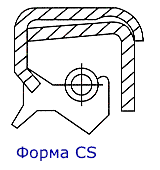 Same
features as those of type C with the addition of a dust lip. Same
features as those of type C with the addition of a dust lip. |
| Home| About us | O-rings | Oil seals | UN seals | Other products | Contact|
© 2004-2013 Satellite Nikis. All rights reserved. Last change on Mar 01, 2013 by RS